In short. The forfettario regime for foreigners is Italy’s flat-rate tax scheme for small businesses and freelancers who hold a VAT number: a 15% substitute tax (5% for the first five years of a new activity, if certain conditions are met), revenue of up to €85,000 and invoices issued without VAT. Non-EU nationals can use it only if they are tax resident in Italy; non-resident EU and EEA nationals only if they earn at least 75% of their total income in Italy.
The forfettario regime is a very common choice for freelancers and small businesses starting out in Italy, because it simplifies both day-to-day compliance and the calculation of tax. For a foreigner, however, the deciding question is a different one: do I meet the requirements, starting with residence? This guide sets out the limits, rates and exclusions, and the points to check if you are a non-EU national or a digital nomad.
Reviewed 18 October 2026. For 2026 the limits and thresholds appear unchanged from 2025. Tax rules can change with each budget law, so always check the latest instructions of the Italian Revenue Agency (Agenzia delle Entrate).
What is the forfettario regime?
Forfettario means flat-rate. It is a favourable tax regime for individuals who hold a VAT number (partita IVA). Instead of working out profit by deducting actual expenses from revenue, you apply to your revenue a profitability coefficient linked to the ATECO code of your activity, the official Italian classification code for the type of activity. A substitute tax is then paid on the resulting income, in place of ordinary income tax (IRPEF) and its surcharges.
Among the main simplifications, invoices are issued without VAT and without withholding tax, and calculating the tax is much simpler than under the ordinary regime. Invoices are still electronic and, above €77.47, carry a €2 revenue stamp (marca da bollo).
Can a foreigner use the forfettario regime?
Yes, but residence matters. In general the regime is reserved for people who are resident in Italy. Non-residents can use it only if they are resident in an EU or EEA state with an adequate exchange of information and earn at least 75% of their total income in Italy.
- Non-EU national who is tax resident in Italy: can use the forfettario regime if the other requirements are met.
- Non-EU national who is not resident in Italy: in general cannot use it.
- EU or EEA national who is not resident in Italy: can use it only if at least 75% of their total income is produced in Italy.
Tax residence is a different concept from a residence permit and from registration with the local civil registry. The guide on taxes and tax residency for digital nomads explains the general criteria.
What are the requirements of the forfettario regime for foreigners in 2026?
| Point | Rule |
|---|---|
| Revenue or fee limit | €85,000 a year. If you carry on several activities, revenue and fees from all ATECO codes are added together. |
| If you exceed the limit | Up to €100,000 in the year, you stay in the regime and leave it from the following year. Above €100,000 you leave it immediately. |
| Employment income | You are excluded if in the previous year you received employment or similar income above €35,000, subject to the exceptions provided by law. |
| Shareholdings | You are excluded if you hold interests in partnerships, professional associations or family businesses, or if you control an SRL (limited liability company) whose activities are related to yours. |
| Other exclusions | Special VAT regimes; mainly selling buildings, building land or new means of transport; activity carried out mostly for current or former employers. |
| Residence | Residents in Italy; non-residents only if resident in the EU or EEA and at least 75% of their income is produced in Italy. |
The full list of exclusions is in Law 190/2014 and in the Revenue Agency’s instructions: have your situation checked before you choose the regime.
How much tax do you pay under the forfettario regime?
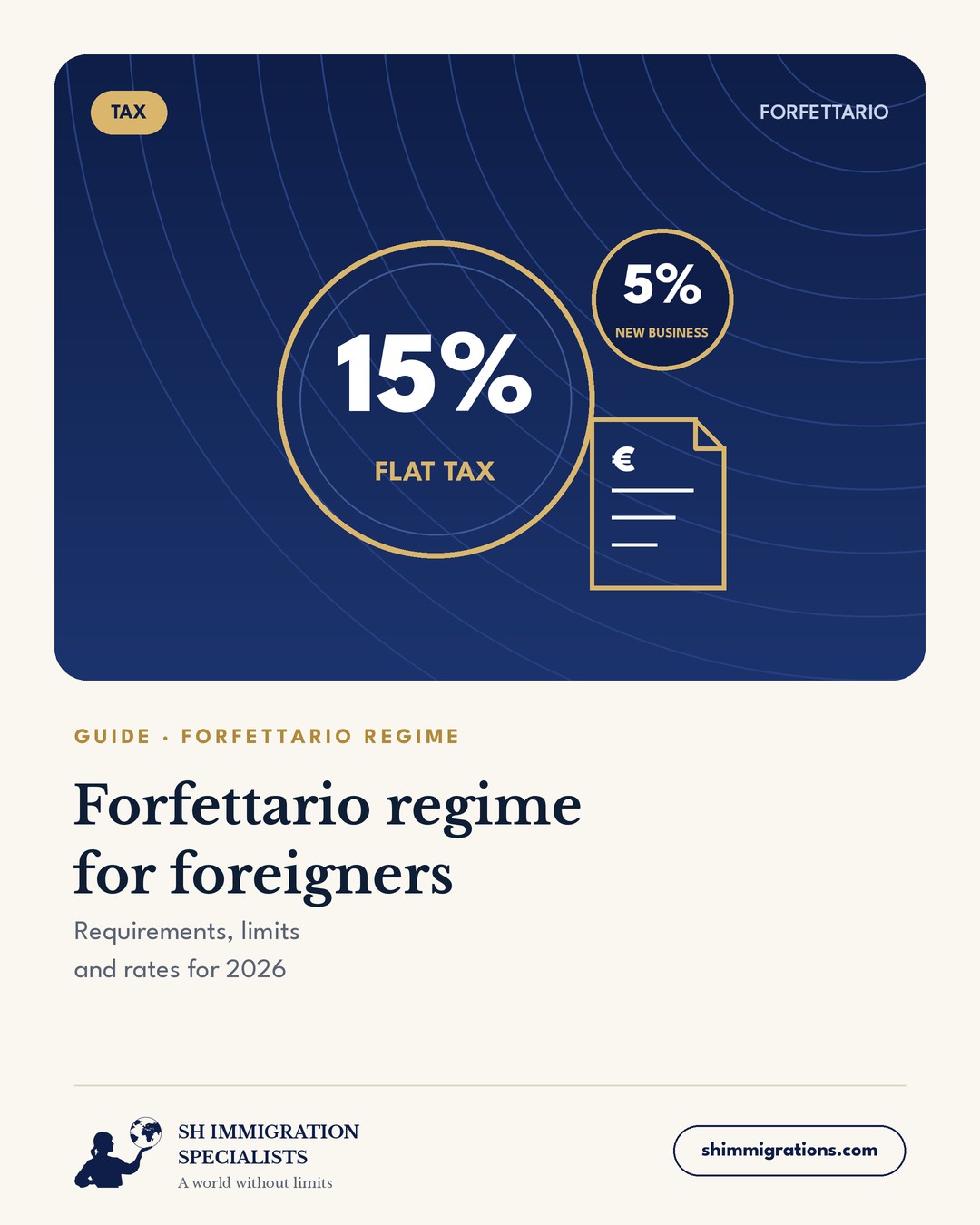
The substitute tax is 15%. For the first five years of a new activity the rate is 5%, if the following conditions are met:
- you have not carried on an artistic, professional or business activity in the previous three years;
- the new activity is not simply the continuation of previous employment or self-employment, apart from a compulsory traineeship;
- if you take over an activity previously carried on by someone else, that activity’s revenue in the previous year did not exceed the entry limit.
Example, only to show how the mechanism works. If the coefficient for your ATECO code were 78% and you invoiced €40,000 in the year, your taxable income would be €31,200 (€40,000 × 78%). The 15% or 5% rate is applied to this amount after deducting the social security contributions you have paid. The real coefficient depends on your ATECO code: ask your tax professional.
What about social security contributions?
Besides the tax, you must pay social security contributions. In general these go to the INPS separate scheme (gestione separata), to the INPS artisans’ and traders’ schemes, or to the pension fund of your profession, depending on your activity. Amounts and rates change and also depend on the profitability coefficient, so check your own position before comparing regimes.
How do you choose the forfettario regime?
You indicate it in the declaration of commencement of activity, form AA9/12, when you open the VAT number. If your VAT number is already open, how you switch depends on the rules for entering the regime: ask your tax professional when and how to notify it. For the opening steps, read the guide on how to open a VAT number (partita IVA) as a foreigner.
Forfettario regime and digital nomads: what should you check?
- Tax residence: a non-EU national who is not tax resident in Italy cannot, in general, use the regime. Check first where you will be considered resident.
- Type of visa and permit: the digital nomad visa covers self-employed remote work, but a visa on its own does not decide your tax treatment.
- Clients and country of origin: taxation in your home country and double taxation treaties need to be assessed case by case.
- Other income and shareholdings: employment income above the threshold or shares in companies may exclude you.
When is the forfettario regime worth it, and when not?
The forfettario regime is often attractive when actual expenses are modest and revenue stays below the threshold. It may be less suitable if you have many deductible expenses, if you need VAT and tax deductions, if you expect to exceed the limits or if you do not meet the residence requirement. There is no rule that fits everyone: you need a simulation on your own figures, with your own expenses and clients.
Frequently asked questions
Can foreigners use the forfettario regime?
Yes, if they meet the requirements. In general the regime is reserved for people who are resident in Italy. Non-residents can use it only if they are resident in an EU or EEA state and produce at least 75% of their total income in Italy. Other exclusions also apply.
Can a non-EU national living abroad use the forfettario regime?
In general, no. Non-residents are excluded, except those resident in an EU or EEA state who produce at least 75% of their income in Italy. A non-EU national therefore has to become tax resident in Italy before being able to choose the forfettario regime.
How much tax do you pay when you start a new activity in Italy?
The standard rate of the regime is 15%. For the first five years of a new activity the rate is 5%, provided you did not carry on any activity in the previous three years and the new activity is not the simple continuation of earlier work.
What happens if my revenue goes above €85,000?
If you stay within €100,000 for the year, you remain in the forfettario regime until the end of that year and leave it from the next one. If you go above €100,000, you leave the regime immediately. It is therefore worth monitoring turnover during the year, not only at year end.
Do I charge VAT on my invoices under the forfettario regime?
No. Invoices under the forfettario regime are issued without VAT and without withholding tax, with the wording required by law. A €2 revenue stamp applies to invoices above €77.47, and invoices must still be issued electronically.
Official sources
- Forfettario regime: what it is – Italian Revenue Agency (Agenzia delle Entrate)
- Circular No. 32/E of 5 December 2023 on the forfettario regime – Agenzia delle Entrate (Italian text)
- Law No. 190 of 23 December 2014, Article 1, paragraphs 54–89 – Normattiva (Italian text)
- VAT registration for individuals (form AA9/12) – Agenzia delle Entrate
The information on 2026 limits and rates was verified on 18 October 2026 against public sources. Always check the official pages above: thresholds and instructions may be updated.
How can SH Immigration Specialists help?
We can help you connect the parts of the journey: a residence permit that allows you to work for yourself, your residence in Italy and, through tax professionals, the choice of regime, the opening of your VAT number and the management of ongoing obligations. Legal advice, appeals and representation before a court are provided by the lawyers of SH Immigration Specialists’ immigration law firm. The full path, step by step, is on our page VAT number and company setup for foreigners in Italy. The outcome depends on the competent authorities. For an assessment, contact us.
This content provides general information and does not constitute legal or tax advice.
Do you have a case like this? Talk to a specialist consultant
In 30 minutes a specialist consultant at SH Immigration Specialists looks at your situation and tells you what to do, which documents you need and which mistakes to avoid. Online from any country or in one of our 8 offices in Italy, also in Arabic, Hindi and Urdu.
Want us to handle it for you? See our residence permit service.
Secure online payment with Stripe. SH Immigration Specialists is not a law firm: appeals and legal advice are handled by the lawyers on the team.
Which other guides may help you?
- How to open a VAT number (partita IVA) in Italy as a foreigner
- Digital nomad taxes in Italy: tax residency and VAT number
- How to open an SRL in Italy as a foreigner: steps, notary and costs
- Self-employment visa and residence permit in Italy
- VAT number and company setup for foreigners in Italy: the full path