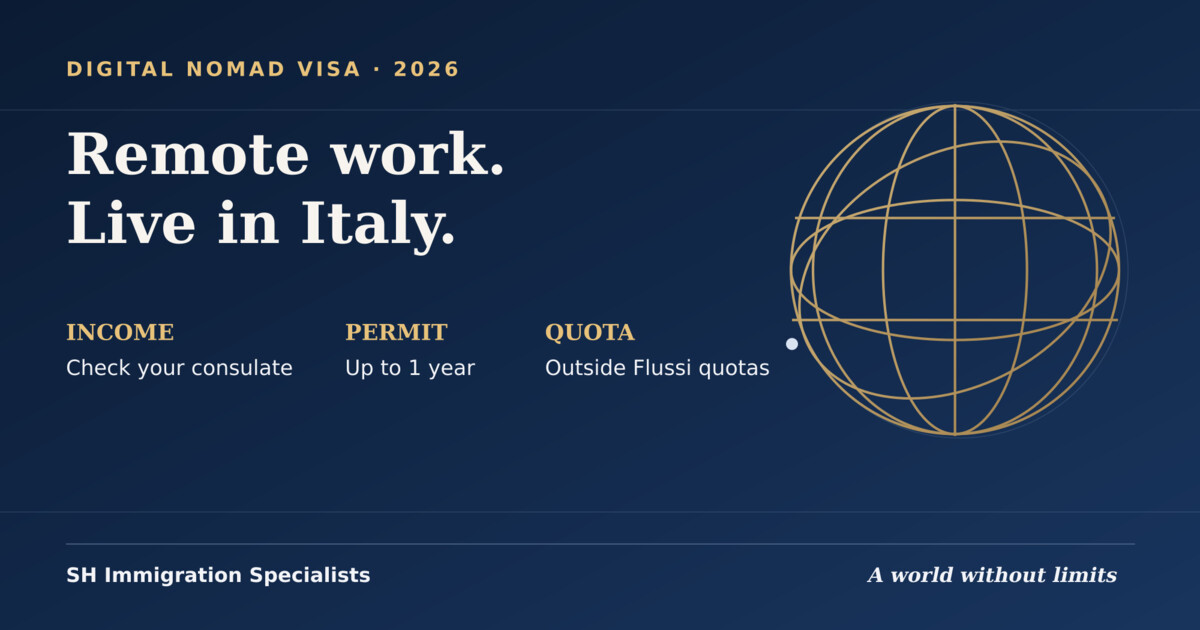
In short. To get a digital nomad visa, Italy requires non-EU applicants to show highly qualified work performed remotely, at least six months of relevant prior experience, lawful income, health insurance and suitable accommodation. The route is outside the Decreto Flussi quota system and does not require a work clearance (nulla osta) for the remote-work procedure. After arrival, you apply for the residence permit at the Questura within eight working days; the permit may be issued for up to one year and renewed annually.
Italy’s digital nomad and remote worker visa allows eligible non-EU nationals to live in Italy while carrying out highly qualified work remotely. Italian law distinguishes self-employed digital nomads from employees or collaborators working remotely. The competent Italian consulate sets the local checklist and verifies the evidence, so confirm the current requirements before booking an appointment.
Reviewed 27 September 2026. Consular checklists do not always use the same income figure or documentary format. This guide explains the national rule; your consulate’s current instructions govern your application.
What is Italy’s digital nomad visa?
The Minister of the Interior’s Decree of 29 February 2024 regulates entry and residence for non-EU nationals who perform highly qualified work using technology that allows them to work remotely.
The rules cover two profiles:
- Digital nomad: works remotely on a self-employed basis, for example as a freelancer or consultant.
- Remote worker: works remotely as an employee or collaborator for an employer or client.
This is not a general visa for anyone who works online. Your professional qualification, work arrangement and supporting evidence must fit the applicable category.
What are the digital nomad visa Italy requirements in 2026?
Highly qualified activity
You must show that your work qualifies as highly skilled under the Italian rules, including the criteria referenced in Article 27-quater of the Consolidated Immigration Act. Depending on your profession, evidence may include a degree, professional qualification, regulated-profession recognition, or documented work experience. The consulate decides which evidence is suitable for your case.
Relevant work experience
The decree requires evidence of at least six months of prior experience in the work you will perform as a digital nomad or remote worker. Contracts, employer or client letters, invoices and other records can help establish the role and continuity; follow the consulate’s required format.
Income: use the legal formula, not one universal figure
The national rule sets minimum annual income from lawful sources at no less than three times the minimum level used for exemption from Italy’s healthcare cost-sharing contribution. It is therefore misleading to present one fixed euro amount as the national threshold for every consulate and every year.
Official consular checklists published in 2026 do not all show the same calculation: some indicate about €25,500, while others use figures closer to €28,000. These are local references, not a single nationwide threshold. Before applying, ask the consulate responsible for your place of residence to confirm the current amount, the income period it reviews and which sources it accepts. If family members are included, confirm how the financial evidence changes.
Health insurance and accommodation
You need health insurance valid for the requested stay and evidence of suitable accommodation in Italy. The accepted policy, coverage, duration and accommodation documents depend on the consular checklist. Do not rely on a short-term policy for a longer application without checking that it is accepted.
Personal and professional documents
The consulate may ask for a valid passport, national visa application form, photograph, proof of residence in its jurisdiction and evidence of your work, qualifications and experience. Remote workers should document their employment or collaboration and the ability to perform the role remotely. Self-employed applicants should document their business activity and client or contractor relationships. If the employer is resident in Italy, Article 3(4)-(5) requires a signed declaration from the employer about specified convictions during the previous five years, together with a copy of valid ID. Provide other police certificates only if the competent checklist requests them.
Which documents should you prepare?
Your competent consulate’s checklist is the definitive list. Typical evidence includes:
- passport, national visa form and photograph;
- proof that you legally reside in the consulate’s jurisdiction;
- degree, professional qualification or other accepted proof of high-skilled status;
- evidence of at least six months of relevant prior experience;
- remote-work contract, employer/client letter or self-employment records;
- lawful-income evidence for the amount and period requested locally;
- health insurance valid for the stay;
- proof of suitable accommodation;
- if the employer is resident in Italy, the declaration required by Article 3(5) of the decree, with a copy of valid ID; translations, apostilles or other items only if the local checklist requests them.
Keep the file consistent: dates, role, income, work history and remote-work arrangement should match across documents. For documents issued outside Italy, check whether translation, apostille or legalisation is required: see our guide to apostille and legalisation of foreign documents.
How do you apply?
- Identify the competent office. Apply through the Italian diplomatic mission responsible for the place where you legally reside.
- Download its latest checklist. Confirm appointment booking, document formats, income calculation and instructions for family members.
- Prepare your evidence. Submit the national visa application in the format required by the consulate and keep a complete copy.
- Attend the appointment. The consulate may ask for clarification or additional documents; procedures and timelines vary.
- Apply for your residence permit after arrival. The decree requires the application at the Questura within eight working days of entering Italy.
This category is outside the Decreto Flussi quotas and does not require a work clearance (nulla osta) for the remote-work procedure. That does not make approval automatic: the consulate assesses the application and its supporting documents. For an overview of other visa types, read our guide to the Italian entry visa.
How long is the residence permit valid and how is it renewed?
The residence permit may be issued for up to one year and can be renewed annually if the required conditions continue to be met. Before expiry, check with the Questura which evidence of work, income, accommodation and insurance it requires for renewal. Our guide to residence permit renewal in Italy explains the general procedure.
Can family members join you?
The decree permits reunification with the family members listed in Article 29(1)(a) and (b) of Italy’s Consolidated Immigration Act, notably a spouse and minor children, subject to the legal conditions. The main applicant’s visa does not automatically grant residence to family members: verify their requirements, income, accommodation and documents separately with the consulate and Questura. See also our guide to family reunification in Italy.
What about taxes and social security?
A visa or residence permit does not by itself determine your tax treatment. Tax residence, income source, employment status, social-security contributions and any double-tax treaty require an individual assessment. Self-employed workers may also have Italian VAT registration and tax-return obligations: see our guide to digital nomad taxes and tax residence in Italy. Seek advice from a tax professional familiar with both countries before relocating.
Frequently asked questions
What is the minimum income for Italy’s digital nomad visa?
The national rule uses a formula: at least three times the minimum level for exemption from healthcare cost-sharing. Consular checklists published in 2026 do not all show the same amount, with references of about €25,500 or closer to €28,000, so confirm the current figure and acceptable income evidence with your competent consulate.
Does the visa require Decreto Flussi quotas or a nulla osta?
No. The decree provides entry outside the Decreto Flussi quotas and does not require a work clearance (nulla osta) for this remote-work procedure. All other eligibility and documentary requirements still apply, including highly qualified work, six months of relevant experience, lawful income, health insurance and suitable accommodation.
What is the difference between a digital nomad and a remote worker?
A digital nomad works remotely on a self-employed basis, for example as a freelancer or consultant; a remote worker has an employment or collaboration relationship with an employer or client. Your documents should show which profile applies and that the work can actually be performed remotely.
How long is the residence permit valid?
It may be issued for up to one year and can be renewed annually if you continue to meet the requirements. You must apply for it at the Questura within eight working days of entering Italy, and check before expiry which evidence the Questura requires for renewal.
Can I bring my family to Italy?
The decree permits reunification with family members listed in Article 29(1)(a) and (b) of the Consolidated Immigration Act, notably a spouse and minor children, subject to the legal conditions. Family members do not obtain residence automatically, so confirm their requirements and documents with the consulate and Questura.
Official sources
- Minister of the Interior Decree of 29 February 2024, Official Gazette of Italy (original Italian text)
- Visa for Italy portal, Ministry of Foreign Affairs
- Consulate General of Italy in Dubai checklist, May 2026 (local instructions; not applicable to every consular district)
- Consulate of Italy in Perth checklist, July 2026 (example of a local income calculation)
Sources were consulted on 15 October 2026. Rules, income thresholds and checklists can change: always check the latest instructions of the competent consulate and Questura.
How can SH Immigration Specialists help?
SH Immigration Specialists provides administrative support for the digital nomad and remote worker visa: checking whether your profile fits the category, reviewing your experience, income and insurance evidence against the consular checklist, preparing translations and apostilles, and helping with the residence permit application after arrival. Support is available in Italian, English, Arabic, Spanish, Urdu and Hindi. For the tax side (VAT number, tax regime, company) see our page on VAT number and company setup for foreigners. The outcome depends on the competent authorities. For an assessment, contact us.
This content provides general information and does not constitute legal advice.
Do you have a case like this? Talk to a specialist consultant
In 30 minutes a specialist consultant at SH Immigration Specialists looks at your situation and tells you what to do, which documents you need and which mistakes to avoid. Online from any country or in one of our 8 offices in Italy, also in Arabic, Hindi and Urdu.
Want us to handle it for you? See our entry visa service.
Secure online payment with Stripe. SH Immigration Specialists is not a law firm: appeals and legal advice are handled by the lawyers on the team.